

By Michael Danielsen
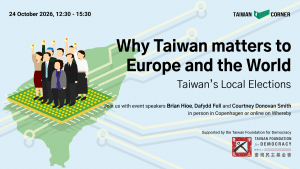
Three leading experts on Taiwanese politics joined Taiwan Corner in Copenhagen on October 24 2026 to discuss Taiwan’s upcoming local elections, the changing political landscape and what the results could mean for Taiwan’s political future.
Taiwan’s local elections matter beyond Taiwan
Taiwan’s local elections rarely receive much attention in Europe. Most international discussions about Taiwan focus on China, military tensions and semiconductors. However, understanding Taiwan also requires an understanding of its democracy, political parties and domestic challenges.
On October 24, Taiwan Corner organized the event “Why Taiwan Matters to Europe and the World – Taiwan’s Local Elections 2026” supported by Taiwan Foundation for Democracy.

The event brought together three leading experts: Brian Hioe, founding editor of New Bloom; Courtney Donovan Smith, political analyst and columnist for the Taipei Times; and Professor Dafydd Fell, Director of the SOAS Centre of Taiwan Studies at SOAS University of London.
The discussion was moderated by Michael Danielsen, Chairman of Taiwan Corner.
Three experts examine Taiwan’s political landscape
The three speakers provided different perspectives on Taiwan’s 2026 local elections, combining political journalism, analysis of current developments and academic research into Taiwan’s democratic system.
The event covered a wide range of topics related to Taiwan’s local elections. It began with an introduction to the “9-in-1” elections and the results of previous local elections, followed by an overview of the current electoral landscape in Taichung, Tainan, Taoyuan, Kaohsiung, New Taipei City and Taipei.

The discussions explored the positions of the established political parties, as well as the prospects of the non-mainstream smaller parties in the upcoming elections and their internal development. This included the prospect of the new Taiwan Go Go alliance of four smaller parties. Speakers also examined the quality of opinion polls and current polling results across several cities, with particular attention to the election campaign in Taipei.

Another topic was Taiwan’s current economic situation and its influence on the political landscape.
During the event we had a dialogue about how the local elections could shape the next presidential election. The audience asked the speakers questions and participated during the roundtable discussion.
The discussion also addressed the internal development of Taiwan’s political parties and the possible consequences of the local elections for the next presidential election.
What are Taiwan’s 9-in-1 elections?
Taiwan’s local elections are known as the 9-in-1 elections because nine categories of local political positions are elected on the same day.
These include mayors, county magistrates, local councilors, township leaders, Indigenous district representatives and village and neighbourhood chiefs.
Taiwan has six special municipalities: Taipei, New Taipei, Taoyuan, Taichung, Tainan and Kaohsiung. Together, they account for approximately two-thirds of Taiwan’s population.

Dafydd Fell and Biran Hioe. Moderator: Michael Danielsen, Chairman of Taiwan Corner
The event began with an introduction to the election system and a review of previous local elections in 2014, 2018 and 2022. In 2022, the Kuomintang (KMT) achieved a strong result in the mayoral and county magistrate elections, winning 14 of the 22 cities and counties, compared with five for the Democratic Progressive Party (DPP). The Taiwan People’s Party won one, while independent candidates won two. This historical perspective provided a starting point for examining the 2026 elections.
Local elections are mainly decided by local issues, candidates and political conditions. However, their results can also influence the national political debate and the leadership of political parties.

Why Taiwan matters to Europe
The discussion also placed Taiwan’s political development in a broader international context.
Taiwan is among the world’s 20 largest economies and plays a central role in global semiconductor production. These technologies are essential for European industries, including cars, computers, telecommunications and industrial equipment.
Economic relations between Europe and Taiwan are also developing, particularly through cooperation in technology and Taiwanese investment in Europe.
For Taiwan Corner, Taiwan’s democratic dimension is important. Taiwan’s political future must be understood through the choices made by the Taiwanese people themselves.


Strong interest from a European audience
The event attracted considerable interest. We reached the target with 50 in-person tickets claimed, which is the full capacity of the venue. Most of the audience were Europeans, together with Taiwanese living in Denmark.
Audience participation was an important part of the programme, with opportunities to ask questions after the presentations and during the final roundtable discussion.
The event demonstrated the value of bringing specialists on Taiwan’s domestic politics directly into dialogue with a European audience.
The event was supported by Taiwan Foundation for Democracy.